
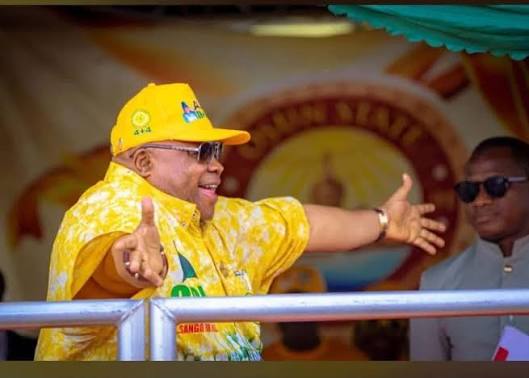
Osun 2026: Adeleke Wins Second Term as Accord Candidate Defeats Oyebamiji
By Orient Foundation
Published: 17 August 2026
Category: Elections | Osun State | Democracy & Governance
Governor Ademola Adeleke of the Accord Party has secured another four-year term as Governor of Osun State after emerging victorious in the August 15, 2026 governorship election.
The election, which attracted intense political competition across the state, ended with Adeleke defeating his closest challenger, All Progressives Congress (APC) candidate Bola Oyebamiji.
The Independent National Electoral Commission (INEC) declared Adeleke the winner after the completion of collation from the state’s 30 Local Government Areas.
According to the final results, Adeleke polled 511,067 votes, while Oyebamiji recorded 444,815 votes. African Democratic Congress (ADC) candidate Najeem Salam finished third with 17,180 votes.
The result gives Adeleke a winning margin of 66,252 votes over Oyebamiji.
Adeleke Takes 19 LGAs as APC Wins 11
The contest was largely a two-way battle between the Accord Party and the APC.
Adeleke secured the highest number of votes in 19 of Osun’s 30 Local Government Areas, while Oyebamiji won the remaining 11 LGAs.
The distribution demonstrated the closely fought nature of the election, with both candidates recording significant victories in different parts of the state.
Among the notable results, Adeleke recorded strong performances in areas including Ede North, Ede South, Iwo, Ife East, Ife Central and Osogbo.
Oyebamiji, meanwhile, secured notable victories in areas including Irewole, Boripe, Ilesa East, Obokun and Atakunmosa West.
Final Results by Local Government Area
The results announced during the state collation process were as follows:
| Local Government | Accord | ADC | APC |
|---|---|---|---|
| Olorunda | 23,514 | 666 | 24,671 |
| Ejigbo | 18,458 | 5,053 | 16,195 |
| Ife South | 13,507 | 290 | 14,678 |
| Olaoluwa | 10,163 | 213 | 10,782 |
| Isokan | 13,765 | 384 | 14,063 |
| Ayedaade | 16,681 | 331 | 15,719 |
| Egbedore | 19,278 | 363 | 11,194 |
| Atakumosa East | 7,872 | 333 | 9,936 |
| Aiyedire | 11,073 | 148 | 9,910 |
| Irewole | 10,934 | 275 | 29,972 |
| Ila | 16,211 | 259 | 12,934 |
| Ede North | 35,427 | 307 | 10,283 |
| Iwo | 27,085 | 588 | 19,660 |
| Atakumosa West | 7,479 | 213 | 10,037 |
| Ifelodun | 21,107 | 509 | 18,396 |
| Ife East | 27,201 | 935 | 18,600 |
| Odo-Otin | 18,003 | 377 | 15,435 |
| Oriade | 21,343 | 423 | 14,863 |
| Osogbo | 36,480 | 1,503 | 30,474 |
| Orolu | 12,352 | 236 | 10,622 |
| Obokun | 12,023 | 205 | 16,120 |
| Irepodun | 14,504 | 249 | 15,713 |
| Boripe | 12,448 | 379 | 19,963 |
| Ife Central | 21,171 | 747 | 15,913 |
| Bolorunduro | 7,118 | 179 | 7,050 |
| Ede South | 26,188 | 390 | 6,219 |
| Ife North | 13,879 | 333 | 9,613 |
| Ilesa West | 16,196 | 673 | 12,756 |
| Ifedayo | 7,427 | 115 | 6,836 |
| Ilesa East | 12,280 | 504 | 16,208 |
What Shaped the Election?
The 2026 Osun election was characterised by strong competition between the incumbent’s Accord Party and the APC.
Adeleke entered the contest with the advantage of incumbency and the opportunity to campaign on the record of his administration. His campaign highlighted developments in infrastructure and other areas of governance.
The governor also retained significant political support within parts of the state, while his familiarity with the electorate provided an important advantage in a closely contested election.
Oyebamiji, on the other hand, contested with substantial political and administrative experience. His background in finance and public administration, together with the organisational strength of the APC, positioned him as the principal challenger to the incumbent.
The APC campaign also benefited from support from prominent political figures and stakeholders.
A Competitive Political Landscape

The election was not limited to the two leading parties.
Najeem Salam of the African Democratic Congress entered the election as another prominent candidate, drawing on his long political career and previous experience as Speaker of the Osun State House of Assembly.
Other political parties also fielded candidates, making the election a broad multi-party contest. However, the final results demonstrated the significant gap between the three leading candidates and the rest of the field.
Election-Day Issues
As voting took place across the state, reports emerged of operational and logistical difficulties in some polling units.
Among the issues reported during the exercise were delays in the arrival of election officials, problems involving the Bimodal Voter Accreditation System (BVAS), isolated incidents of violence and allegations of vote trading.
Civil society observers also monitored the election across polling units and reported a number of challenges requiring attention in future elections.
These developments underline the continuing importance of strengthening electoral logistics, voter protection and the effective deployment of election technology.
The Importance of Peaceful Post-Election Engagement
With the final result now declared, attention shifts from campaigning to governance.
The election has produced a clear winner, but the period after an election remains important for democratic stability. Political parties, candidates and supporters have a responsibility to respect lawful processes and promote peace.
For the government, the renewed mandate also comes with expectations from citizens who will look to the administration to address development needs across all parts of Osun State, irrespective of how individual communities voted.
Adeleke’s Second Term
Adeleke’s re-election means that he will continue as Governor of Osun State for another four-year term.
His first term provided voters with an opportunity to assess his administration, while the 2026 election has now provided a fresh mandate.
The second term will therefore bring renewed expectations around infrastructure, healthcare, agriculture, education, employment, public-sector administration and broader economic development.
Final Election Figures
The final statewide results for the leading candidates were:
- Ademola Adeleke — Accord: 511,067 votes
- Bola Oyebamiji — APC: 444,815 votes
- Najeem Salam — ADC: 17,180 votes
Adeleke won 19 Local Government Areas, while Oyebamiji won 11.
Looking Ahead
The 2026 Osun governorship election has concluded, but its implications will extend beyond the result itself.
For citizens and civil society organisations, the next phase should focus on accountability, effective governance and the implementation of policies that improve the lives of residents.
Orient Foundation will continue to monitor developments in Osun State and provide civic information aimed at promoting democratic participation, transparency and accountable governance.
Editorial Disclaimer: This report is published for civic education and public-interest information. It is not an endorsement of any political party, candidate or political position.
